
Executive Summary
Government Regulation (Peraturan Pemerintah or PP) Number 43 of 2025 on Financial Reporting introduces a new financial reporting framework in Indonesia through the Platform Bersama Pelaporan Keuangan (PBPK), or the financial reporting single window. The regulation was enacted and promulgated on 19 September 2025 and covers five main areas: financial statements, the Standards Committee, PBPK administration, support for the financial reporting ecosystem, and administrative sanctions.
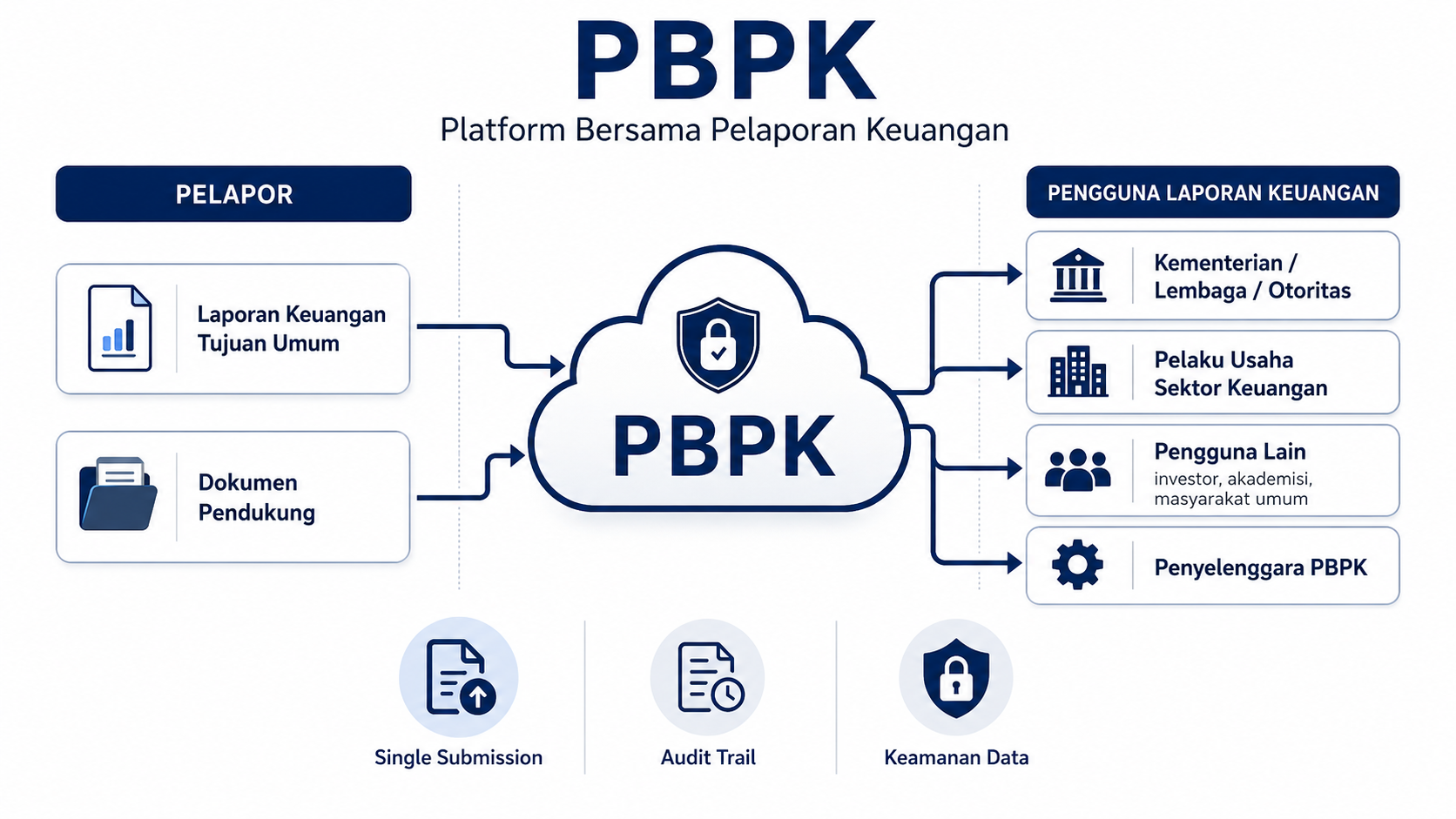
In substance, PP 43/2025 does not merely introduce a new place to submit financial statements. It establishes a more centralized, standardized, and integrated financial reporting ecosystem that may be used by ministries, government institutions, authorities, financial sector businesses, and other users in accordance with applicable laws and regulations. PBPK is defined as an electronic system for the single submission of financial statements.
Key point:
Starting in 2027, financial statement submission through PBPK must be implemented no later than 2027 for issuers and public companies in the capital market sector. For other reporting entities, implementation will be phased in based on a determination by the Minister of Finance after coordination with the relevant ministries, institutions, and/or authorities.
Companies should begin understanding PP 43/2025 early because financial statements submitted through PBPK will become valid and binding reports for use by financial statement users. This means that the quality of bookkeeping, financial reporting standards, audit documentation, data consistency, and internal controls will become increasingly important in a company’s relationship with regulators, banks, investors, and other parties that rely on financial statements.
Main Article
Background of PP 43 of 2025
PP 43 of 2025 was issued as an implementing regulation of Law Number 4 of 2023 on the Development and Strengthening of the Financial Sector. The regulation responds to the need to harmonize national financial reporting, as financial statement submission obligations were previously spread across various sectoral regulations and could create uncertainty for companies.
In the elucidation of PP 43/2025, the government emphasizes that transparent financial reporting may reduce the risk of market failure, strengthen confidence in financial markets, improve corporate accountability, and support economic decision-making. With PBPK, financial statements are expected to become a more credible, centralized, and comparable source of data.
For businesses, this change means that financial statements will no longer function only as internal documents or as documents prepared for tax and credit purposes. Financial statements will become part of a national database that may be accessed and used by authorized parties in accordance with the law.
What Is PBPK?
PBPK stands for Platform Bersama Pelaporan Keuangan, an electronic system for the single submission of financial statements. Through PBPK, a reporting entity submits general purpose financial statements, and PBPK then forwards the reports to the relevant ministries, institutions, and/or authorities.
The administration of PBPK is based on several important principles, including data security and confidentiality, service availability, electronic service delivery, fulfillment of the needs of reporting entities and financial statement users, and the availability of an audit trail. PBPK is administered by a working unit under and responsible to the Minister of Finance.
| PBPK Aspect | Regulation under PP 43/2025 | Impact on Companies |
|---|---|---|
| Reporting system | General purpose financial statements must be submitted through PBPK | Companies need to prepare a digital reporting process |
| Report users | Ministries/institutions, authorities, financial sector businesses, PBPK administrators, and other users | Financial statements may be used by a broader group of authorized parties |
| Access rights | Reporting entities and report users must have access rights | Internal account administration and authorization controls need to be managed |
| Audit trail | PBPK provides an audit trail | Submitted data must be traceable and accountable |
| Data storage | Reports are stored for at least 10 years in the PBPK database | Companies need to maintain long-term data consistency |
Who Is Considered a Reporting Entity?
PP 43/2025 uses the term Reporting Entity (Pelapor), which refers to financial sector business actors and parties that interact commercially with the financial sector as owners of financial statements. Reporting entities are required to prepare and submit financial statements.
Financial sector business actors include, among others, institutions in banking, capital markets, insurance, pension funds, financing institutions, pawnshops, guarantee institutions, export financing institutions, technology-based peer-to-peer lending providers, institutions managing mandatory public funds, financial market infrastructure, payment systems, and other financial sector business actors in accordance with applicable laws and regulations.
In addition, parties that have business interactions with the financial sector may also become reporting entities. This group includes entities that maintain bookkeeping, whether incorporated or unincorporated; individuals who are required to submit financial statements when interacting with the financial sector; and individuals who are required to maintain bookkeeping under tax regulations. Such business interactions include becoming a bank debtor, a debtor of a financing company, an issuer or public company in the capital market, an issuer in the money market, or other business interactions with the financial sector.
Important clarification:
Popular headlines suggesting that “all companies must report starting in 2027” should be read carefully. PP 43/2025 provides for phased implementation through PBPK. The year 2027 is expressly mentioned for issuers and public companies in the capital market sector, while other reporting entities will follow the implementation stages determined by the Minister of Finance.
Types of Financial Statements and Documents to Be Submitted
The financial statements covered by PP 43/2025 are financial statements prepared for general purposes. These financial statements must be prepared in full accordance with Financial Reporting Standards and applicable laws and regulations.
For reporting through PBPK, the submission includes financial statements and supporting documents as required. If the reporting entity is a parent entity, the submission includes consolidated financial statements, the parent entity’s financial statements as additional information, and supporting documents where required. For entities subject to a statutory audit requirement, the documents submitted include audited financial statements, the independent auditor’s report, and supporting documents where necessary.
For parent entities subject to audit, the obligation may include audited consolidated financial statements, the parent entity’s financial statements, the independent auditor’s report on the consolidated financial statements, and supporting documents. The independent auditor’s report must also be registered in the independent auditor report registration system administered by the ministry responsible for government affairs in the field of finance. If the report has not been registered, the financial statements are deemed incomplete.
Responsibilities of Directors, Business Owners, and Financial Statement Preparers
PP 43/2025 emphasizes that financial statements must be prepared by individuals with competence and integrity. In addition to internal preparers, financial statements may also be prepared by practicing accountants or public accountants as supporting professionals in the financial sector.
However, engaging professional services does not remove the responsibility of the reporting entity. The reporting entity remains responsible for the financial statements prepared and for the accuracy of the data and information submitted through PBPK. This responsibility commitment is stated in a separate declaration within the financial statements, signed by the business owner or the highest-ranking official and/or another authorized officer.
From a corporate governance perspective, this is important. Management cannot simply delegate bookkeeping to accounting staff or consultants without oversight. Companies need to ensure that transaction recording, reconciliations, book closing, financial statement preparation, and management review are performed consistently and properly documented.
The Role of Audit and Public Accountant Independence
For entities subject to audit requirements, PP 43/2025 connects financial reporting with audit quality. Reporting entities that are required to have their financial statements audited must take into account the transparency report of the public accounting firm before entering into the engagement, and must maintain independence by not intervening with the public accountant from the start of the engagement, during the audit process, and until the audit opinion is issued.
This provision strengthens the role of audit as part of a credible financial reporting ecosystem. For companies, audit should not be treated merely as an annual formality. Document readiness, accounting record quality, accounting estimates, transaction evidence, tax reconciliations, and management support during the audit will increasingly determine whether reports submitted through PBPK are complete and credible.
Implementation Timeline Starting in 2027
PP 43/2025 provides that financial statement submission through PBPK will be implemented in stages. For issuers and public companies in the capital market sector, submission through PBPK must be implemented no later than 2027. For other reporting entities, implementation will be based on needs and stages determined by the Minister of Finance after coordination with the relevant ministries, institutions, and/or authorities.
Accordingly, companies that are not issuers or public companies should still monitor future implementing regulations. PP 43/2025 also states that further provisions on PBPK administration procedures will be regulated by a Ministerial Regulation.
| Reporting Entity Category | PBPK Implementation Stage | Business Notes |
|---|---|---|
| Issuers and public companies in the capital market sector | No later than 2027 | Need to prepare financial reporting and audit trails early |
| Other financial sector business actors | Phased implementation based on ministerial determination | Need to monitor coordination among the Ministry of Finance, OJK, Bank Indonesia, LPS, and other relevant authorities |
| Entities interacting with the financial sector | Phased implementation according to further regulations | Need to consider relationships with banks, financing companies, capital markets, and bookkeeping obligations |
| Reporting entities with audited financial statements | Subject to sectoral obligations and PBPK implementation stages | Need to ensure the independent auditor’s report is registered and complete |
Impact on Companies’ Accounting Systems and Compliance
From a business perspective, PP 43/2025 encourages companies to improve the quality of financial reporting. Financial statements submitted through PBPK will become a centralized source of information and may serve as a reference point where there are differences between the submitted financial statements and financial statements circulated among financial statement users.
Companies should ensure that commercial financial statements, bookkeeping data, tax reports, reports to banks, and reports to investors are not prepared separately without adequate reconciliation. Inconsistencies between different versions of financial statements may raise questions from regulators, creditors, auditors, or other stakeholders.
PP 43/2025 also highlights the importance of quality management. Reporting entities in the form of entities are required to maintain quality management by applying an internal control system in the financial statement preparation process in accordance with good corporate governance principles.
Administrative Sanctions and Compliance Risk
Ministries, institutions, and/or authorized authorities may impose administrative sanctions on reporting entities for violations of financial statement preparation and submission obligations. The form and mechanism of administrative sanctions are determined by the relevant ministries, institutions, and/or authorities in accordance with applicable laws and regulations.
Accordingly, compliance risk does not arise only from late submission. It may also arise from the quality of financial statement preparation, completeness of supporting documents, validity of the independent auditor’s report, and consistency of submitted data. Companies with multiple entities, branches, manual record-keeping systems, or poorly organized tax reconciliations should begin improving their processes before PBPK obligations fully apply to their sector.
What Companies Should Prepare
Companies should begin assessing their internal readiness from accounting, audit, technology, and governance perspectives. Key areas to review include bookkeeping quality, competence of financial statement preparers, transaction documentation, reconciliation of significant accounts, compliance with accounting standards, annual audit readiness, and access controls over financial data.
For companies subject to audit requirements, coordination with public accountants should begin early so that the audit process is not completed merely as an administrative exercise, but results in financial statements that meet the completeness requirements under PP 43/2025. For corporate groups, special attention should be given to consolidated financial statements, parent entity financial statements, and supporting documents that may be requested by the authorities.
PP 43 of 2025 marks an important shift in Indonesia’s financial reporting landscape. Going forward, financial reporting will become increasingly digital, integrated, and data-driven. Companies that prepare their accounting systems, internal controls, and documentation early will be in a better position to comply with PBPK requirements and build credibility before regulators, investors, banks, and business partners.