
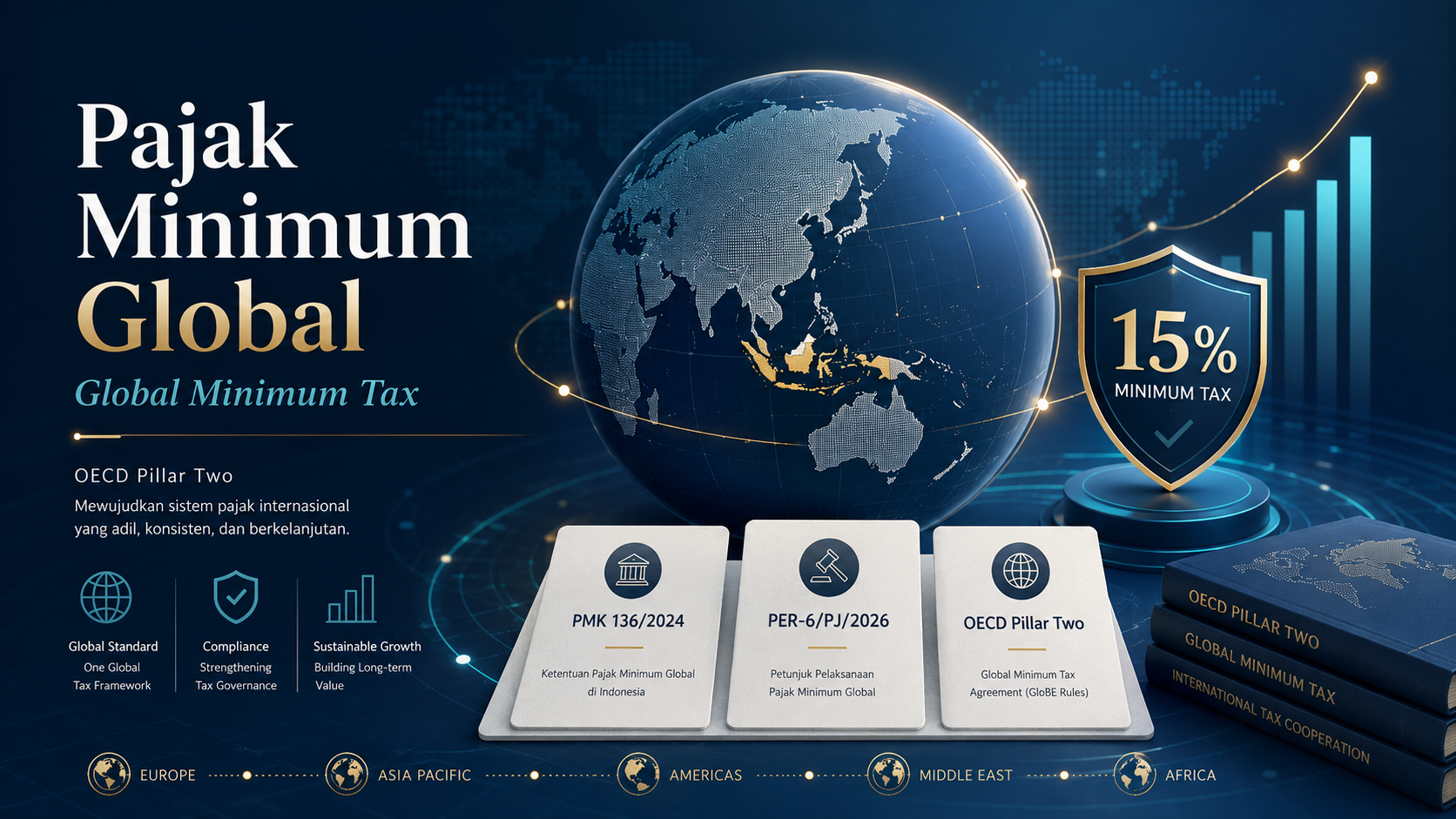
Executive Summary
Indonesia has adopted the Global Minimum Tax framework under the OECD/G20 Pillar Two initiative through Minister of Finance Regulation No. 136 of 2024 (PMK 136/2024). The regulation introduces a minimum effective tax rate of 15% for large multinational enterprise groups operating across jurisdictions.
At the international level, Pillar Two is designed to ensure that large multinational groups pay a minimum level of tax in each jurisdiction where they operate. The OECD Global Anti-Base Erosion (GloBE) Rules apply a top-up tax where the effective tax rate in a jurisdiction falls below the agreed minimum rate. OECD – Global Minimum Tax
In Indonesia, PMK 136/2024 came into force on 1 January 2025, with the Undertaxed Payment Rule (UTPR) applying from 1 January 2026. The regulation applies mainly to constituent entities of multinational enterprise groups with annual consolidated group revenue of at least EUR750 million, tested in at least two of the four fiscal years preceding the relevant GloBE fiscal year. PMK 136/2024
The technical implementation procedures were further regulated through Director General of Taxes Regulation No. PER-6/PJ/2026, issued on 4 May 2026. This regulation sets out the procedures for GloBE taxpayer status registration, annual GloBE income tax returns, Domestic Minimum Top-up Tax (DMTT) returns, UTPR returns, GloBE Information Return (GIR), notification, tax payment, supervision, audit, and dispute resolution. PER-6/PJ/2026
For multinational groups with operations in Indonesia, the Global Minimum Tax is not merely a tax calculation issue. It affects accounting data, consolidated financial reporting, transfer pricing, tax incentives, deferred tax, group reporting timelines, and coordination between Indonesian subsidiaries and overseas parent entities.
Main Article
Why the Global Minimum Tax Matters for Indonesia
The Global Minimum Tax represents a major shift in international taxation. Under the traditional tax system, multinational enterprise groups could benefit significantly from low-tax jurisdictions or domestic tax incentives. Pillar Two changes this by introducing a minimum effective tax rate of 15% at the jurisdictional level.
If a multinational group’s effective tax rate in a jurisdiction is below 15%, a top-up tax may arise. The objective is to reduce profit shifting and limit excessive tax competition between jurisdictions. Indonesia’s tax authority has also emphasized that the Global Minimum Tax helps reduce the “race to the bottom” in international corporate tax competition. DGT – Indonesia’s Strategic Pivot in the Era of Global Minimum Tax
For Indonesia, one of the most important policy considerations is the protection of domestic taxing rights. Without a domestic top-up tax mechanism, additional tax on low-taxed Indonesian income could potentially be collected by another jurisdiction, such as the jurisdiction of the ultimate parent entity. By introducing DMTT, Indonesia seeks to ensure that top-up tax related to Indonesian constituent entities can be collected in Indonesia.
Entities Covered by the GloBE Rules
PMK 136/2024 does not apply to all companies. The rules primarily target large multinational enterprise groups that meet the global revenue threshold.
| Area | Main Requirement |
|---|---|
| Covered group | Multinational enterprise group with constituent entities in more than one jurisdiction |
| Revenue threshold | Annual consolidated group revenue of at least EUR750 million |
| Testing period | Revenue threshold met in at least two of the four fiscal years before the relevant GloBE fiscal year |
| Main source of data | Consolidated financial statements of the ultimate parent entity |
| New groups | If the threshold is met in the first and second fiscal years, the rules apply from the third fiscal year |
PMK 136/2024 also excludes certain entities from the scope of the GloBE Rules, including government entities, international organizations, non-profit organizations, pension fund entities, investment fund entities that are ultimate parent entities, and real estate investment fund entities that are ultimate parent entities. PMK 136/2024
As a result, most standalone domestic small and medium-sized enterprises in Indonesia are not directly affected. However, an Indonesian subsidiary, branch, or permanent establishment of a foreign multinational group may fall within the GloBE framework if the multinational group meets the EUR750 million consolidated revenue threshold.
Core Mechanisms: IIR, DMTT, and UTPR
Indonesia’s Global Minimum Tax framework includes three key mechanisms: Income Inclusion Rule (IIR), Domestic Minimum Top-up Tax (DMTT), and Undertaxed Payment Rule (UTPR).
| Mechanism | Function | General Impact |
|---|---|---|
| Income Inclusion Rule (IIR) | Imposes top-up tax on a domestic parent entity in respect of low-taxed constituent entities in the group | Relevant for Indonesian parent entities of multinational groups |
| Domestic Minimum Top-up Tax (DMTT) | Allows Indonesia to impose domestic top-up tax where Indonesian constituent entities have an effective tax rate below 15% | Protects Indonesia’s taxing rights |
| Undertaxed Payment Rule (UTPR) | Applies where IIR is not applied or the top-up tax has not been fully collected | Acts as a backstop rule from 1 January 2026 |
The IIR applies to a domestic parent entity when another constituent entity in the group is subject to an effective tax rate below the minimum rate. DMTT applies domestically to Indonesian constituent entities, while UTPR operates as a secondary rule where the top-up tax has not been fully collected under the IIR. PMK 136/2024
General Approach to Top-up Tax Calculation
The Global Minimum Tax is not calculated by simply comparing Indonesia’s statutory corporate income tax rate with the 15% minimum rate. Instead, the GloBE calculation focuses on the GloBE Effective Tax Rate (ETR) for each jurisdiction.
In general, the GloBE ETR is calculated by dividing the adjusted covered taxes of all constituent entities in a jurisdiction by the net GloBE income of that jurisdiction. This requires a detailed analysis of accounting income, covered taxes, current tax, deferred tax, permanent differences, and specific GloBE adjustments. PMK 136/2024
| Step | Explanation |
|---|---|
| 1. Determine GloBE income or loss | Based on financial accounting data, adjusted under the GloBE framework |
| 2. Determine adjusted covered taxes | Including adjustments to current tax, deferred tax, and other relevant tax items |
| 3. Calculate jurisdictional ETR | Adjusted covered taxes divided by net GloBE income |
| 4. Compare with the 15% minimum rate | If the ETR is below 15%, a top-up tax may arise |
| 5. Determine top-up tax | Based on the top-up tax percentage, excess profit, substance-based income exclusion, additional current top-up tax, and qualified domestic minimum top-up tax |
Under PMK 136/2024, the top-up tax for a jurisdiction is generally calculated by multiplying the top-up tax percentage by excess profit, adding any additional current top-up tax, and reducing it by qualified domestic minimum top-up tax where applicable. The top-up tax percentage is the difference between the 15% minimum rate and the jurisdictional ETR.
Safe Harbour and Simplification Measures
Pillar Two includes several simplification measures to reduce compliance burdens in specific circumstances. PMK 136/2024 recognizes different forms of safe harbour, including permanent safe harbour, transitional Country-by-Country Reporting (CbCR) safe harbour, CbCR safe harbour for certain entities and groups, transitional UTPR safe harbour, and simplified calculations safe harbour for non-material constituent entities. PMK 136/2024
A safe harbour may result in the top-up tax being deemed zero for a jurisdiction if specific requirements are met. For example, a de minimis test may be satisfied where the average GloBE revenue of a jurisdiction is below EUR10 million and the average net GloBE income is below EUR1 million, or where the jurisdiction records a net GloBE loss for the relevant period and comparison years.
For business groups, safe harbour analysis is important because it may reduce the need for full GloBE calculations in certain jurisdictions. However, safe harbour should not be assumed automatically. The supporting data, calculation basis, and documentation must be reviewed carefully.
Administrative Obligations under PER-6/PJ/2026
PER-6/PJ/2026 provides the procedural framework for implementing the Global Minimum Tax in Indonesia. A GloBE taxpayer that meets the criteria must apply for the addition of GloBE taxpayer status no later than nine months after the end of the first GloBE fiscal year. The application is submitted electronically through the taxpayer portal. The Directorate General of Taxes may also add the GloBE taxpayer status by authority if the taxpayer does not submit the application. PER-6/PJ/2026
The main administrative obligations are summarized below:
| Obligation | Deadline | Notes |
|---|---|---|
| Addition of GloBE taxpayer status | 9 months after the end of the first GloBE fiscal year | Submitted electronically through the taxpayer portal |
| Annual GloBE/DMTT/UTPR income tax returns | 4 months after the end of the GloBE fiscal year | The first year may be extended by up to 2 months |
| GloBE Information Return (GIR) | 15 months after the end of the GloBE fiscal year | First year: 18 months |
| Notification | 15 months after the end of the GloBE fiscal year | First year: 18 months; not required if GIR has been submitted |
| Payment of top-up tax | No later than the end of the GloBE fiscal year | Applies to IIR, DMTT, and UTPR |
The annual GloBE income tax return consists of sections for the GloBE income tax return, UTPR income tax return, and DMTT income tax return. The GloBE income tax return is filed by the ultimate parent entity, the UTPR return is filed where UTPR top-up tax is allocated to the Indonesian GloBE taxpayer, and the DMTT return is filed by each Indonesian GloBE taxpayer. PER-6/PJ/2026
The GIR and notification procedures are also important because the proof of submission must generally be attached to the annual GloBE income tax return, unless the proof of submission is already available in the tax authority’s information system.
Impact on Multinational Groups and Indonesian Entities
The Global Minimum Tax requires multinational groups to integrate tax, accounting, consolidation, transfer pricing, and jurisdictional reporting processes. Indonesian subsidiaries may need to coordinate closely with overseas parent entities to obtain consolidated financial data, CbCR information, GloBE adjustments, and group-level tax calculations.
Groups that receive tax incentives in Indonesia should also reassess the broader Pillar Two impact. A domestic tax incentive may reduce Indonesian tax payable under local law, but if it results in a GloBE ETR below 15%, the benefit may be offset by DMTT or another top-up tax mechanism. Therefore, the tax impact should be assessed at both the local entity level and the multinational group level.
PER-6/PJ/2026 also strengthens the administrative and audit framework. The Indonesian tax authority may request explanations, conduct discussions, invite taxpayers, perform visits, request transfer pricing documentation, request consolidated financial statements, and request documents supporting the top-up tax calculation. The tax authority may also conduct audits to test compliance with GloBE obligations. PER-6/PJ/2026
For Indonesian constituent entities of multinational groups, preparation should not be delayed until the filing deadline. Relevant teams should identify whether the group is within scope, determine the role of the Indonesian entity, assess whether DMTT may apply, review safe harbour eligibility, and ensure that accounting and tax data can support the required calculations and documentation.
The practical implication is clear: the Global Minimum Tax is not only an issue for the global headquarters. Indonesian subsidiaries, branches, permanent establishments, joint ventures, and finance teams must understand how PMK 136/2024 and PER-6/PJ/2026 affect their reporting obligations, tax position, and documentation readiness.